It is not without considerable irony that I believe that AI has at least one useful application: producing feature images for posts like this, so I don’t have to learn how to do this or resort to using some awful generic stock image.
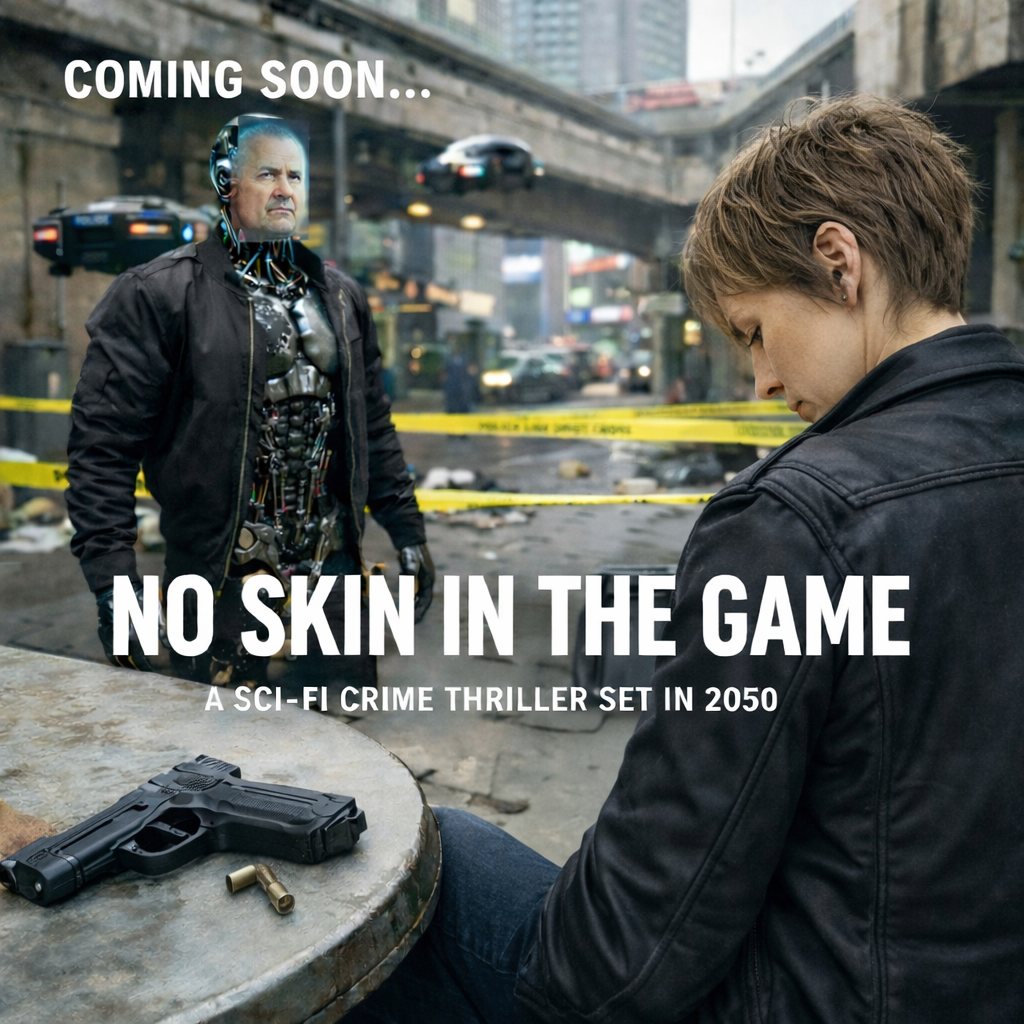
As our world was being turned upside down with the pending arrival of my orphaned nephew to come and live with us, as our fourth and youngest child, my wife Tara and I made one of our many long trips, driving from London to Exeter, some one hundred and eighty miles. We were discussing the way that AI was presented in The Many and The Few when we happened on a new idea for a separate stand-alone story. The result was something so pertinent to the imminent arrival of AI in all our lives that I was profoundly glad that I started it, when AI really did arrive. I realised that, quite accidentally, it was going to be a very marketable idea – a happy coincidence, since I had always treated this past time as primarily self-indulgent. I never had any delusions that I would ever make a success at writing novels, however, it was a truly relevant story and I would not do justice to it if I simply self-published it on Amazon, as I had done with first three books of The Many and The Few, without some effort to bring it to the attention of potential readers, who just might agree with me, and like it.
That prelude over, I can tell you that this story is a SciFi Crime Thriller, set in 2050. I draw a little on my short stint as a police constable during my mid-twenties (another story), and I completely deviate from the writing style and millennia-spanning scope of The Many and The Few. For a start, the action takes place in just one week, with no time-jumping, and largely from a single person’s perspective, with far more vernacular suited to the crime genre.
What follows is a summary of the world-building.
In one generation from now, as ageing populations begin to see their numbers fall off suddenly from old age, an old trick is rising to change things. Those that had engaged in the earlier social media networks and been busy on the internet had left behind a large digital footprint, which could be used to build a model of them post-mortem. This model could be played back by AI as a simulation of that person. In a twist to the infeasibly difficult fiction of an “uploaded consciousness”, this route extends the notion of contemporary deep-fakes and AI generated actors in an almost inevitable way.
Visiting deceased relatives at a mausoleum would no longer be a one-way conversation. Basic models would be known as elans and they would present as sound-bite holograms with limited interactivity. More prolific producers of their digital, negative space could be highly interactive eidolons, capable of everything short of sentience. Only those that regularly recorded everything 24/7, using a device known as a LifeCam, would be “resurrected” as an immortal, sentient version of themselves.
Many people consider this truly a route to immortality since the results were so indistinguishable from the veritas human prior to death.
Ersatz models were common-place in the police, providing support and comfort to officers losing their partners, and both retaining and employing their valuable experience. Mechanised android bodies called peons were also extensively used to host ersatz people, but there was a twist: politicians had reacted badly to this revelation and brought about legislation declaring all ersatz as “second-class” citizens with very few rights.
This is the world in which our story is set, not that far away now.
There is a very high-profile murder. Detective Sergeant Dorothy Hennessy struggles to make sense of a world that is changing too fast as she tries to solve the case and redeem herself.